
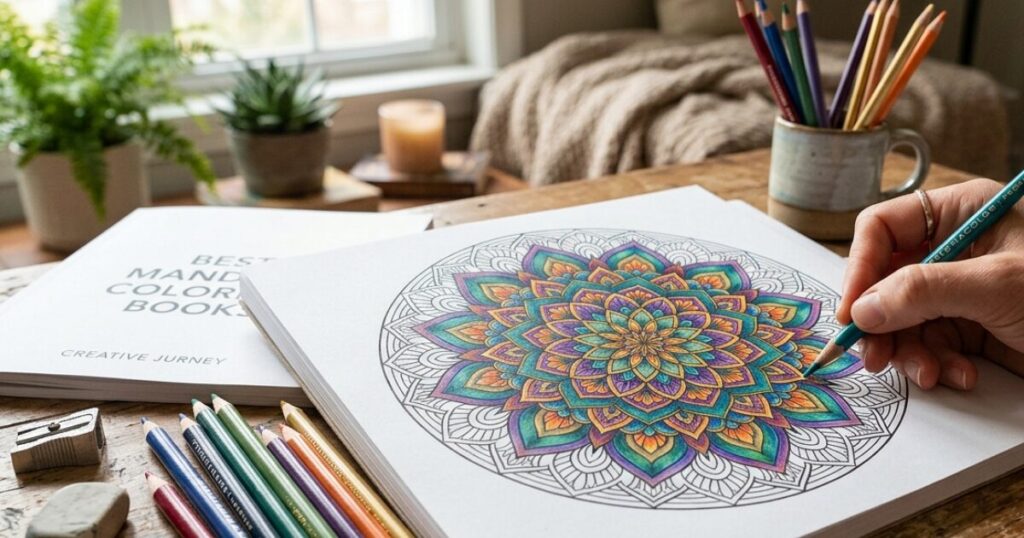
Of all the formats in adult coloring, mandalas occupy a unique position. They’re simultaneously the most accessible and the most capable of extraordinary complexity. A simple mandala can be completed in thirty minutes with a handful of pencils and almost no technique. An intricate one can occupy hours across multiple sessions and reward the most sophisticated color theory you can bring to it. The same basic format serves the complete beginner and the dedicated expert.
That range is part of what has made mandala coloring books one of the most consistently popular segments of the adult coloring market since the genre’s explosion in the mid-2010s. This guide covers the appeal, the mechanics, the technique, and the best books — from the most approachable to the most demanding — so you can find exactly what the format has to offer you.
Why Mandalas Are So Popular for Stress Relief
The word mandala comes from Sanskrit and means “circle.” In Hindu and Buddhist traditions, mandalas are sacred geometric diagrams representing the universe — used in meditation, ritual, and spiritual practice for thousands of years. The circular, symmetrical structure isn’t arbitrary; it’s intentional. Circles are complete. They have no beginning and no end. The symmetry creates order. The repetition creates rhythm. These qualities, embedded in the form itself, are part of why coloring mandalas produces a specific kind of mental calm that other coloring subjects don’t quite replicate.
Psychologist Carl Jung famously drew mandalas every morning as part of his self-analysis practice, describing them as representations of the self and tools for psychological integration. He believed the process of creating or engaging with mandalas facilitated a kind of internal ordering — bringing scattered mental states into a coherent whole. Whether or not you accept the depth of that framework, the practical experience of coloring a mandala supports something like it: the repetitive, symmetrical work tends to quiet the mind in a way that is noticeably different from coloring a landscape or a floral illustration.
From a more straightforward psychological perspective, mandalas are also unusually good at inducing flow states. The repetitive patterning creates a predictable, rhythmic task — you know what’s coming in the next section because it mirrors what you just completed — and this predictability reduces cognitive load while keeping the hands engaged. Research on mindfulness and coloring specifically (a relatively young field, but a growing one) has found that geometric patterns like mandalas are particularly effective at reducing anxiety measures compared to free-form or representational coloring.
There’s also a practical reason mandalas are popular: they are the most forgiving format in adult coloring. Because they are abstract and symmetrical, there are no wrong color choices — no reference image against which your purple flower can be judged incorrect. The symmetry also means that whatever you do to one section is mirrored in the others, so even modest technique produces a visually harmonious result. Beginners succeed at mandalas in a way that can take much longer to achieve with realistic illustration.
What to Look for in a Mandala Coloring Book
Not all mandala books are created equal, and the differences matter more than they might appear on a quick browse. Here’s what separates a genuinely good mandala book from one that will frustrate you after the first few pages.
- Print quality and line crispness. Mandalas live and die by the precision of their lines. Blurry, low-resolution printing makes intricate mandala work look muddy and makes it difficult to distinguish individual sections. A well-printed mandala book has clean, sharp lines at every scale. Hold the book up to the light and look closely at the finest details — if they look fuzzy, the print quality isn’t sufficient for serious coloring.
- Paper weight. Mandala coloring often involves sustained, repeated passes in relatively small sections, which builds up pressure over time. Paper below 90 gsm will pill, warp, and resist blending under this kind of sustained work. Look for 100 gsm or above for colored pencil work; if you plan to use markers, look for 160 gsm or higher, or single-sided pages explicitly designed for marker use.
- A genuine range of complexity within the book. The best mandala books include designs at multiple detail levels, not a single uniform complexity throughout. This lets you choose pages that match your mood and energy level — a quick, simple design for a relaxed evening, a more intricate one for a focused session. Books that are uniformly very complex or uniformly very simple wear out their welcome faster.
- Single-sided pages. This matters more for mandalas than for other coloring formats because mandala work often involves significant pressure and repeated layering. Printing on both sides of the page means any sustained pressure risks embossing through to the reverse. Single-sided pages also let you remove and frame finished work, which many mandala colorists do.
- Page size. Larger mandalas give you more room to work with, which makes blending, layering, and detailed color choices more practical. Very small mandalas — particularly in compact, portable books — can be charming but limit what’s possible technically. For serious coloring, look for full-page mandala designs on pages no smaller than 8 x 8 inches.
- Design variety. Pure geometric mandalas, floral mandalas, animal mandalas, Celtic-influenced designs, Tibetan-influenced designs, Art Nouveau-inflected patterns — the mandala format encompasses a remarkable range of visual approaches. A book that offers genuine variety across its designs stays interesting across many sessions in a way that a book of near-identical circular patterns does not.