
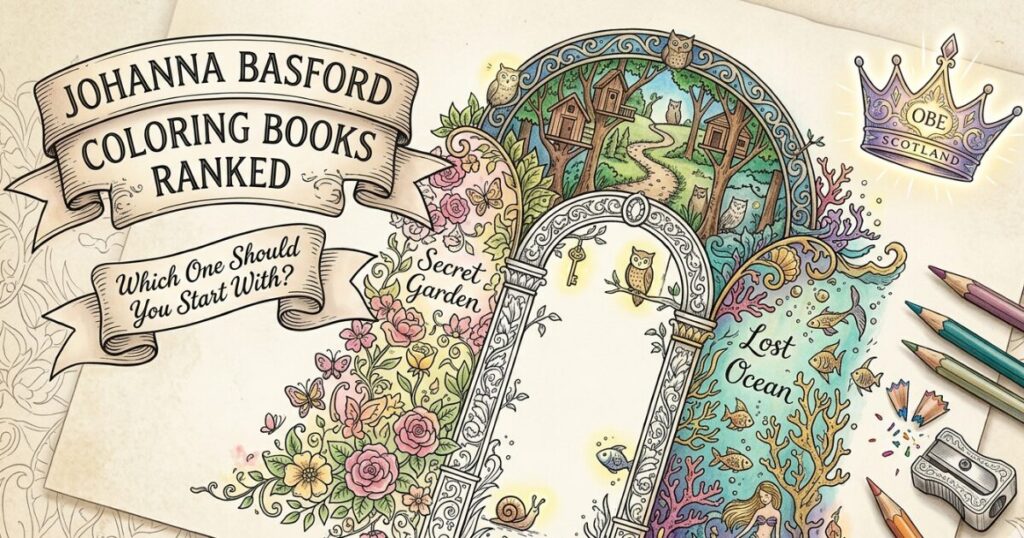
If you’ve spent any time in the adult coloring world, you’ve encountered Johanna Basford. Her name appears on more shelves, more wishlists, and more coloring community recommendation threads than virtually any other artist in the genre. She didn’t just publish a successful coloring book — she essentially invented the modern adult coloring book market as we know it.
That popularity means she’s also one of the most common sources of beginner confusion. There are more than a dozen Basford titles to choose from, they vary meaningfully in difficulty and style, and the advice online tends toward the enthusiastic rather than the specific. This guide cuts through that with a clear-eyed look at every major book, ranked by difficulty and by style, so you can find your ideal starting point.
Who Is Johanna Basford and Why Does She Dominate the Niche?
Johanna Basford is a Scottish illustrator born in 1983 who grew up on her family’s fish farm in Aberdeenshire. She studied textile design at Duncan of Jordanstone College of Art and Design in Dundee, graduating in 2005, and went on to build a commercial illustration career working with clients including Sony, Nike, Tate Modern, and Starbucks. Her illustrations are entirely hand-drawn, created with traditional pens and pencils — she has been openly resistant to digital tools, believing hand-drawn work carries a warmth that pixels can’t replicate.
In 2013, she published Secret Garden: An Inky Treasure Hunt and Colouring Book, and almost nothing in the publishing world was the same afterward. The book sold more than 10 million copies within two years, debuted on the New York Times Best Seller list, and single-handedly demonstrated that there was a vast, underserved adult audience hungry for detailed, sophisticated coloring content. Publishers around the world rushed to capitalize on the trend she’d created. Basford herself has since sold more than 21 million books worldwide and was appointed an Officer of the Order of the British Empire (OBE) in 2016 for services to art and entrepreneurship.
What sets her work apart is its consistency and its character. Every Basford book shares a visual language: densely packed botanical and fantastical illustration, intricate linework with hidden details and tiny creatures tucked into corners, and a sense of whimsy that never tips into childishness. Her style is immediately recognizable — once you’ve colored one Basford page, you know what a Basford page is.
That recognizability is part of why she dominates the niche. She didn’t just publish a book. She built a world, and a decade-long catalog of work that invites you to keep exploring it.
Quick Overview of Every Major Basford Coloring Book
This covers Basford’s primary coloring titles — the standalone books designed for coloring rather than the calendars, journals, mini editions, or instructional books. Here’s the complete picture at a glance.
- Secret Garden (2013) — The one that started it all. A garden-themed treasure hunt with hidden objects throughout. Dense botanical illustration with flowers, insects, and garden scenes. Single-sided pages. Widely regarded as the definitive Basford entry point.
- Enchanted Forest (2015) — A step up in complexity from Secret Garden, with a woodland fantasy theme. Features towering trees, woodland creatures, and fairy-tale scenes. Slightly more intricate than Secret Garden but in the same spirit. One of her most beloved books.
- Lost Ocean (2015) — An underwater adventure through coral reefs, ocean depths, and sea creatures. More open and fluid than the forest and garden books — the aquatic setting gives the illustrations more white space. A more relaxing coloring experience.
- Magical Jungle (2016) — Tropical and lush, with dense jungle foliage, exotic animals, and botanical detail. Returns to the density of Enchanted Forest with a warmer, more vibrant palette potential. The most complex of the mid-period books.
- Johanna’s Christmas (2016) — A festive book featuring holiday-themed illustrations: Christmas trees, wreaths, baubles, winter flora, and seasonal scenes. Lighter and more accessible than many of her nature books. Great for seasonal coloring or as a gift.
- Ivy and the Inky Butterfly (2017) — A storybook-format coloring book that follows a narrative about a girl named Ivy and a butterfly guide through an enchanted world. Half of the pages carry story text alongside illustrations, half are full-page art. A unique format in the Basford catalog.
- World of Flowers (2018) — A global botanical tour drawing on her grandfather’s old botanical reference books, covering flowers from around the world. Returns to double-sided pages and is dense with floral detail. A strong choice for botanical illustration enthusiasts.
- Worlds of Wonder (2021) — A more expansive, imagination-driven book featuring fantastical landscapes: floating islands, enchanted castles, underwater cities, treetop villages. Broader in scope than earlier books with more varied page compositions.
- Magical Worlds (2024) — Her most recent major release, continuing the Worlds of Wonder fantasy direction with faraway lands, enchanted castles, and inky realms. Features underwater cities, cozy cottages, and marvelous treehouses.
Ranked by Difficulty Level (Beginner to Advanced)
Difficulty in a Basford book is determined by a combination of factors: the density of the linework, the size of the individual spaces to fill, the amount of white space, and the complexity of the color decisions each page invites. Here’s how the main books stack up from most approachable to most demanding.
Most Approachable
- 1. Johanna’s Christmas The holiday theme brings lighter, more open illustrations than her nature books. Many pages feature larger areas to fill and a more festive, forgiving visual logic. A low-pressure entry point.
- 2. Lost Ocean The underwater setting gives the pages a looser, more flowing quality. More open space between elements, softer organic forms, and a subject matter that forgives imprecise color choices. Excellent for beginners.
- 3. Secret Garden Basford’s debut and still one of her most accessible titles. The garden theme provides a clear, intuitive visual world, and many pages balance detail with breathing room. A natural starting point.
Intermediate
- 4. Ivy and the Inky Butterfly The storybook format means some pages are lighter than a standard Basford spread, while others are densely illustrated. The narrative structure also gives you a clear direction for color choices.
- 5. Enchanted Forest Slightly more intricate than Secret Garden, with taller, denser compositions. The forest setting creates more vertical visual complexity. A satisfying step up once you’re comfortable with Secret Garden.
- 6. Worlds of Wonder More compositionally varied than earlier books, with some pages featuring expansive fantasy vistas that require thoughtful color planning. The broader subject range also demands more creative decision-making.
- 7. World of Flowers Dense botanical detail on double-sided pages. The complexity here is in the layered floral illustration — distinguishing and coloring individual petals and stems in tightly packed compositions requires patience and precision.
Most Challenging
- 8. Magical Jungle The densest and most demanding of the mid-period books. Tropical foliage, exotic animals, and layer upon layer of overlapping botanical detail. Beautiful, but requires real patience and color planning to do well.
- 9. Magical Worlds (2024) The most recent major release continues the complexity of the Worlds of Wonder direction with additional architectural and landscape detail. For colorists who want a fully realized fantasy world to inhabit across many sessions.
Ranked by Style: Floral, Fantasy, and Nature
If difficulty is less of a concern and you’re drawn to a specific visual world, here’s how the books break down by theme and aesthetic.
Primarily Floral and Botanical
- World of Flowers — The most purely botanical of all Basford’s books. Inspired by her grandfather’s botanical reference collection, it’s the right choice if flowers are your primary interest.
- Secret Garden — Gardens, blooms, and botanical detail throughout. Less strict than World of Flowers in its botanical accuracy — more whimsy mixed in — but deeply floral in character.
- Johanna’s Christmas — Seasonal flora — wreaths, poinsettias, holly, winter berries — woven through the holiday theme. A floral choice with a festive frame.
Fantasy and Story-Driven
- Enchanted Forest — Fairy-tale woodland with hidden details and a sense of story throughout every page. The most storybook-like of the nature books.
- Ivy and the Inky Butterfly — The only Basford book with an actual narrative. If you want to color your way through a story, this is your book.
- Worlds of Wonder — Pure imaginative fantasy: floating islands, enchanted kingdoms, impossible architecture. The most overtly fantastical of the catalog.
- Magical Worlds (2024) — A continuation of the Worlds of Wonder fantasy direction with new landscapes, structures, and creatures.
Nature and Wildlife
- Lost Ocean — Sea creatures, coral reefs, ocean flora, and underwater architecture. The most wildlife-focused of the early books.
- Magical Jungle — Tropical birds, exotic animals, and lush foliage. Nature-focused but with a fantasy warmth rather than strict realism.
- Enchanted Forest — Woodland animals, trees, mushrooms, and forest flora. Sits at the intersection of nature and fantasy.
Which Book Is Best for Your First Basford Experience?
The community answer is almost always Secret Garden, and it’s a reasonable default — but the right first Basford book depends on who you are and what you’re looking for.
If you’re a complete beginner: Lost Ocean
Lost Ocean’s aquatic setting produces illustrations with more open space and more fluid forms than the densely packed woodland and garden books. Coloring the ocean is also inherently forgiving — there’s no single “right” color palette for an underwater scene, which means you can experiment freely without worrying about realism. The result still looks beautiful even with modest technique.
If you want the classic Basford experience: Secret Garden
There’s a reason this is still the book most people recommend first. It’s Basford at her most confident and her most characteristic — intricate without being overwhelming, whimsical without being childish, and full of the hidden details and botanical richness that define her style. If you want to understand what Basford is, Secret Garden is the most direct answer.
If you love forests and fairy tales: Enchanted Forest
Many experienced colorists actually prefer Enchanted Forest to Secret Garden as an entry point, because the woodland setting gives more variety of tone and texture than the garden. The towering trees, forest animals, and fairy-tale scenes feel more atmospheric and offer a wider range of creative choices. If the idea of a magical woodland appeals to you more than a walled garden, start here.
If you want something light and festive: Johanna’s Christmas
Don’t overlook the Christmas book because it seems seasonal. It’s among the most accessible of the catalog and works perfectly well as a year-round coloring experience — the illustrations are beautiful regardless of season. If the density of the nature books feels intimidating, this is a gentler introduction to Basford’s style with a little more breathing room.
If you want a story: Ivy and the Inky Butterfly
The narrative format makes it uniquely satisfying as a coloring experience — you’re not just filling pages, you’re coloring your way through a journey. The mix of lighter text pages and fully illustrated coloring pages also makes it less exhausting than the denser books. A lovely choice if you’ve ever wished a coloring book had a plot.
Tips Specific to Coloring Basford’s Intricate Linework
Basford’s illustrations present specific challenges that standard coloring advice doesn’t fully address. Here’s what experienced Basford colorists have learned from working with her books specifically.
- Work with a sharp pencil at all times. Basford’s linework is fine, and the spaces between elements are often very small. A blunt pencil will bleed color across lines and fill tiny spaces with unintended color. Sharpen frequently — more often than you think you need to.
- Plan your color palette before you start each page. Basford’s pages have many elements that flow into each other. If you pick up whatever pencil is nearest, you’ll end up with color clashes that are difficult to undo. Spend a few minutes looking at the page before you begin, deciding which color families will go where, so the page reads as a unified composition rather than a patchwork.
- Use a consistent light source. Because her illustrations are so layered and complex, pages can look flat if every element is the same brightness. Decide where the light is coming from before you start and apply slightly darker tones to the sides of elements facing away from it. Even a subtle value shift dramatically improves the finished result.
- Color in sections, not all over the page. It’s tempting to color all the flowers first, then all the leaves, then all the backgrounds. But coloring in sections — completing one area of the page fully before moving to the next — helps you maintain color consistency and spot balance issues while they’re still fixable.
- Don’t fear the white space. Many Basford pages include areas of deliberate white space — blank background, unillustrated sections, intentional breathing room. Beginning colorists often feel compelled to fill every inch. Resist this. Leaving some white adds contrast and makes the colored areas pop. Some of the most beautiful Basford coloring leaves significant white showing.
- Try a limited palette for your first page. The complexity of Basford’s linework makes color decisions feel overwhelming. Restrict yourself to four to six pencils for your first attempt — two or three main colors plus some neutrals — and let the variation come from pressure and layering rather than a large number of different hues. The result will look more deliberate and harmonious.
- Use the hidden details as navigation points. Almost every Basford page contains hidden animals, faces, or objects tucked into the corners and foliage. Before you start coloring, find as many as you can. Using these as landmarks helps you mentally divide the page into manageable sections and often suggests natural color boundaries you might otherwise miss.
- Protect completed areas with scrap paper. With so much detail across large pages, your hand is constantly resting on finished work. A small piece of clean paper placed under your hand prevents smearing and keeps your completed areas pristine as you work toward the edges.
Johanna Basford’s books have a way of turning casual colorists into dedicated ones. There’s something about the density of her world — the hidden creatures, the layered botanical detail, the sense that the illustration rewards close attention — that makes finishing a page genuinely satisfying in a way that simpler coloring doesn’t quite match. Once you finish your first Basford page, you’ll understand why people color the same books multiple times.
Start where the style calls to you. There’s no wrong door into the forest.