
If you’ve spent any time in adult coloring communities, you’ve almost certainly encountered the word Zentangle. It appears on book covers, in art supply stores, and across creative forums — sometimes used interchangeably with doodling or coloring, sometimes treated as something far more specific. The confusion is understandable. To the casual observer, Zentangle and adult coloring can look remarkably similar: both involve pen and paper, both produce intricate imagery, and both are celebrated for their calming, meditative qualities.
But Zentangle is its own distinct practice with its own philosophy, method, and community. Understanding what it actually is — and how it differs from coloring — opens up a whole new creative avenue, one that complements rather than competes with the coloring books already on your shelf.
The Origins of Zentangle
Zentangle was founded in 2004 by Rick Roberts, a longtime meditator who had spent years in a monk-like lifestyle, and Maria Thomas, an accomplished calligrapher and professional artist based in Whitinsville, Massachusetts. The name reflects their pairing — as they put it, “He’s Zen and she’s tangle.”
The origin story begins on a quiet afternoon in 2003, when Roberts interrupted Thomas while she was adding decorative patterns to the background of a large illuminated letter. Thomas later described the experience of that absorbed, pattern-drawing state as one of complete immersion — feelings of timelessness and effortlessness that are hallmarks of a flow state. Roberts, drawing on his meditation background, immediately recognized what had happened. The two began discussing whether those same qualities could be made accessible to anyone, not just trained calligraphers.
The motivation was deeply personal. At art fairs, Thomas would inscribe botanical prints for customers while they watched — and those customers would consistently express both admiration and resignation: they wished they could do what she did, then immediately listed all the reasons why they couldn’t. Time, talent, space, patience. Roberts and Thomas took that list seriously and set about designing a creative method that removed every barrier on it.
They retreated to a bed and breakfast in western Massachusetts to formalize the idea, recording their conversations in a blank book over several days. By the time they left, the Zentangle Method was essentially complete. The Certified Zentangle Teacher (CZT) program launched in 2009, and the method has since spread to over 72 countries with more than 7,000 trained teachers worldwide.
The core philosophy is captured in one sentence: “Anything is possible one stroke at a time.” Alongside it sits the practice’s most important rule: there are no mistakes in Zentangle. What might seem like an error simply becomes part of the pattern.
How Zentangle Works: Structured Patterns vs. Free Coloring
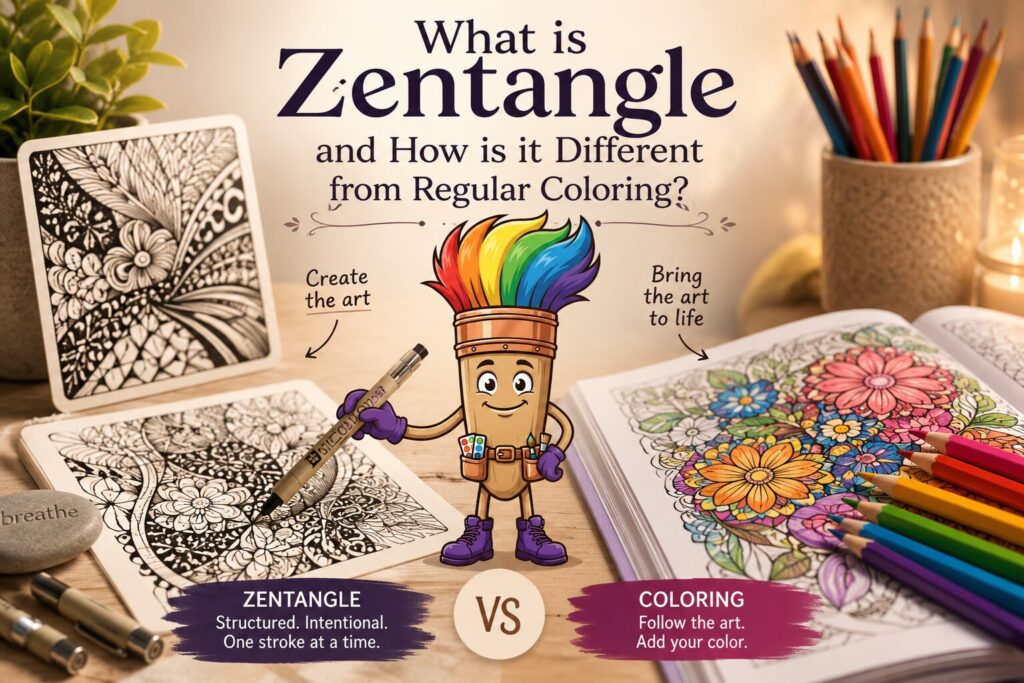
The most fundamental difference between Zentangle and coloring is this: in coloring, the artwork already exists and you bring it to life with color. In Zentangle, you create the artwork itself, stroke by stroke, from a blank surface.
A standard Zentangle is drawn on a 3½-inch square paper tile — a deliberate choice, as the small format makes the practice feel manageable and non-intimidating. The method follows eight intentional steps: beginning with gratitude for the time you’re setting aside, adding pencil dots in each corner, drawing a border, then creating a light pencil “string” — an organic, freeform line that divides the tile into sections. Each section is then filled with a “tangle,” which is a structured, repeatable pattern drawn with a black pen.
Tangles are the vocabulary of Zentangle. Each has a name — Hollibaugh, Printemps, Crescent Moon, Mooka — and is drawn by following a sequence of simple strokes. There are over 163 official tangles, each with step-by-step instructions called “step-outs.” No single tangle requires advanced drawing skill. Each is built from the most elementary marks: lines, dots, curves, and S-curves. The complexity of a finished tile emerges from the combination of these simple elements, not from any single difficult technique.
This is where Zentangle diverges sharply from doodling, with which it is often confused. Doodling is improvisational and typically unconscious — something you do while your attention is elsewhere. Zentangle is the opposite: it requires deliberate, present-moment focus on each individual stroke. The practice is also distinct from coloring in that it is done in black ink on white or off-white paper. Color can be incorporated in what practitioners call Zentangle-Inspired Art (ZIA), but the core practice is monochromatic.
Because every mark is intentional and no eraser is used, Zentangle trains a particular kind of creative confidence: the ability to commit to a stroke, accept what appears on the paper, and build forward from there. This is fundamentally different from coloring, where the act of creation is always guided by an existing image and tools are inherently correctable.
The Meditative Benefits Specific to Zentangle
Both coloring and Zentangle are associated with stress relief and mental calm, but the mechanisms are different — and Zentangle’s benefits have attracted a growing body of clinical research.
A 2024 study published in Brain and Behavior used EEG to measure neural activity in participants during Zentangle sessions. Researchers found increased activity across theta, alpha, beta, and gamma brain wave bands, along with alterations in the brain’s functional connectivity. Participants reported greater cognitive focus, emotional calmness, and reduced stress and anxiety. The authors concluded that Zentangle functions as an effective mindfulness practice, with neural signatures consistent with established meditation research.
Other studies have found that Zentangle mitigated stress and improved wellbeing among healthcare workers, reduced depressive symptoms and fostered self-compassion in older adults, and — in an eight-week program — reduced psychiatric symptoms and increased mindfulness in people with serious mental illness. Roberts and Thomas have worked with hospitals and colleges to explore Zentangle’s applications in pain management, depression, and substance recovery.
The reason Zentangle produces these effects more consistently than casual doodling likely comes down to intentionality. The eight-step ritual — beginning with gratitude, ending with appreciation — frames each session as a deliberate act of self-care. The requirement to focus on each stroke, without planning the overall outcome in advance, produces something close to the focused attention of formal meditation. Unlike coloring, which can be done while watching television or listening to a podcast, Zentangle generally calls for your full attention.
The “no mistakes” principle also carries distinct psychological weight. Anxiety about making errors is one of the primary barriers to creative engagement for adults. Zentangle dissolves this barrier by design: what looks like a mistake is simply the next element to work with. This shifts the practitioner’s relationship to imperfection in a way that has real therapeutic value.
How Zentangle and Coloring Can Complement Each Other
Rather than choosing between Zentangle and coloring, many practitioners find that the two practices strengthen each other in meaningful ways.
Zentangle develops your eye for pattern and detail. Working with structured tangles teaches you to see complex imagery as a collection of repeating, manageable units. This skill transfers directly to coloring: a dense fantasy or botanical illustration that once felt overwhelming becomes easier to parse when you can identify the underlying pattern logic within it.
Coloring builds your color intuition. Because Zentangle is traditionally monochromatic, colorists who also practice Zentangle can bring their understanding of palette, contrast, and value directly into their tangle work when exploring ZIA. The two skills cross-pollinate.
Both practices train sustained attention. The meditative quality of both activities is real, and practicing one deepens your capacity for the other. Colorists who add Zentangle to their practice often report greater patience with complex coloring pages. Tanglers who color find their shading and value work improving.
Zentangle-Inspired Art bridges both worlds. ZIA allows practitioners to use tangle patterns in larger formats, in color, and within representational images — blending the structured mark-making of Zentangle with the color and imagery more familiar to coloring enthusiasts. Many adult coloring books now incorporate Zentangle-style pattern elements, and many tanglers add watercolor washes or colored pencil shading to finished tiles.
The communities overlap considerably too. If you attend a coloring group or follow coloring artists on social media, you’ll find Zentangle enthusiasts in the same spaces. The creative values are shared: a commitment to the process over the product, an appreciation for intricate handwork, and a recognition that making art is itself the reward.
Getting Started with Zentangle: What You Need
One of Zentangle’s most appealing qualities is its minimal supply requirement. You do not need an art background, an expensive setup, or much space. The entire practice can be conducted at a kitchen table with three items.
The Essential Supplies
Paper tiles. The official Zentangle tile is a 3½-inch square of high-quality, cotton-fiber paper. Its texture responds well to both pen and pencil, and its weight prevents bleed-through. Official tiles are available through Zentangle’s website and art supply retailers. Beginners can start on any smooth, white cardstock-weight paper while they explore whether the practice suits them.
A black pen. The recommended tool is a Sakura Micron pigma pen, which produces consistent, archival-quality lines in a range of nib sizes. The 01 (fine) and 05 (medium) sizes are most commonly used. These pens are waterproof once dry, which matters if you plan to add watercolor washes later.
A pencil. Used for the initial corner dots and the string — the light guideline that organizes the tile before inking begins — and optionally for shading once the tile is complete. A standard graphite pencil works fine.
A tortillon or blending stump (optional). Used to smooth pencil shading on finished tiles. Many practitioners add shading as the final step, and blending the graphite creates a sense of depth and dimension that elevates the finished piece considerably.
Your First Steps
Before drawing a single tangle, spend a few minutes learning two or three official patterns from step-out guides. The Zentangle website, TanglePatterns.com, and YouTube all offer free step-out tutorials. Choose patterns with different visual textures — one with straight lines, one with curves, one with a more organic feel — so your first tile has variety.
Draw your string lightly, fill each section with one of your chosen tangles, and resist the urge to plan the outcome. The goal of your first tile is not a beautiful finished piece — it’s familiarization with the process. Most practitioners find the second tile considerably more comfortable than the first, and the fifth considerably more comfortable than the second.
Resources and Books to Explore Zentangle Further
The Zentangle community has produced an abundance of learning resources, from official founder publications to independent books by Certified Zentangle Teachers.
Books
Zentangle Primer Vol. 1 by Rick Roberts and Maria Thomas. The definitive foundational text, written by the method’s founders. It covers basic techniques, shading, how to approach what feels like a mistake, and the deeper philosophy of the practice. This is the book most Certified Zentangle Teachers recommend first.
One Zentangle a Day by Beckah Krahula, CZT. A structured six-week course that walks beginners through the practice one day at a time. It goes beyond simple pattern tutorials to address creative habits, confidence-building, and the mindset behind sustained practice. Many practitioners cite this as the book that made the method click for them.
Made in the Shade: A Zentangle Workbook. A focused guide specifically on shading — the skill that transforms a flat tile into a dimensional, polished piece of art. Recommended once you’ve completed your first few tiles and are ready to deepen your technique.
The Beauty of Zentangle by Various Artists. A large-format showcase of finished work from 137 tangle artists worldwide, including 37 patterns to learn. Less instructional than the above titles, but invaluable as inspiration and an illustration of how varied and sophisticated tangle art can become.
Totally Tangled by Sandy Bartholomew, CZT. A popular introduction to ZIA that expands beyond the traditional tile format into larger, more varied creative applications. A good next step for colorists who want to blend their existing skills with tangle techniques.
Online Resources
Zentangle.com. The official website includes a beginner’s getting-started section, a searchable directory of Certified Zentangle Teachers in over 40 countries, the Kitchen Table Tangles video series featuring the founders, and access to the Zentangle Mosaic app — a community platform where practitioners worldwide share their finished tiles.
TanglePatterns.com. An extensive independently-run index of official and community-created tangle patterns, each with step-out guides and links to tutorials. One of the most useful reference sites for practitioners at any level.
The Zentangle YouTube channel. Free video content from the founders and the broader CZT community, including beginner tutorials, themed project packs, and the publicly available Kitchen Table Tangles series.
Certified Zentangle Teachers. In-person or online workshops with a CZT are the fastest way to internalize the method. The official website’s teacher directory makes it easy to find someone teaching in your area or offering virtual sessions. The CZT community is notably welcoming to beginners.
Final Thoughts
Zentangle and adult coloring are not rivals — they’re neighbors in the same creative landscape, drawing on related skills and offering related rewards. Coloring gives you a world to inhabit and asks you to bring it to life with color. Zentangle gives you a blank square of paper and asks you to fill it, one deliberate stroke at a time, with patterns that are simultaneously simple and endlessly varied.
If you’re a colorist curious about Zentangle, the barrier to entry is genuinely low: a pen, a pencil, a small square of paper, and the willingness to make marks without knowing exactly where they’ll lead. That uncertainty, rather than being a source of anxiety, is precisely the point.